
Pests
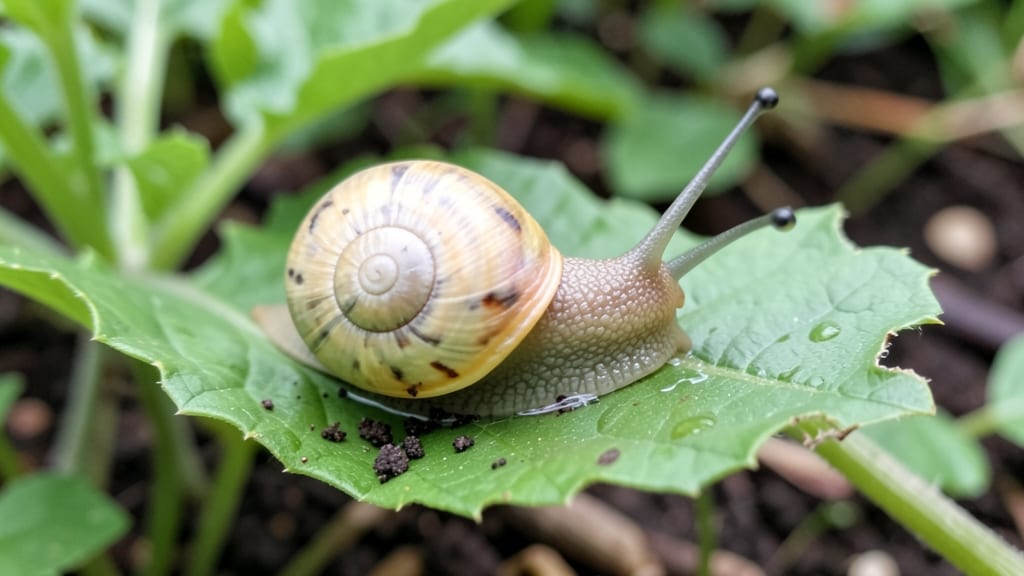
Understanding garden snail anatomy reveals how their spiral shell, muscular foot, retractable head with two antennae, slimy mucus layer, breathing pore, and radula all work together to ensure survival in gardens and beyond.
These tiny creatures rely on their coiled shells for protection, secreting mucus to glide smoothly while evading predators and avoiding dehydration. 🔥 The two antennae—one long and sensory, the other shorter with eyes—help them navigate darkness and detect threats.
Their radula, a sandpaper-like tongue, efficiently scrapes plant surfaces for food, while the breathing pore allows gas exchange when retracted into their shell.
What makes their anatomy fascinating is how each part adapts to their nocturnal lifestyle. The slimy trail isn't just for movement—it creates a chemical barrier that confuses predators' scent trails. Meanwhile, their muscular foot acts like a suction cup, letting them scale surfaces with surprising strength.
For gardeners, recognizing these features helps distinguish snails from slugs and determine the best control methods.
💡 In This Article
- How Garden Snail Body Parts Function for Survival
- Identifying Garden Snail Anatomy in the Wild
How garden snail body parts function for survival
The coiled spiral shell of garden snails serves as an armored fortress, protecting their soft bodies from predators and environmental threats. This calcium carbonate structure grows throughout their lifetime, with each new coil adding about 0.5-1.5 millimeters per year.
The shell's tight spiral design minimizes surface area exposed to predators while maximizing internal space for their organs. When threatened, they retract completely inside, sealing the entrance with a mucus plug that hardens upon drying—creating a nearly impenetrable barrier. 🔥
Their muscular foot functions like a biological vacuum cleaner, using wave-like contractions to propel them forward while secreting a continuous layer of mucus.
This slimy substance contains glycoproteins that reduce friction by up to 70% while also acting as a chemical shield—predators often avoid following the trail due to its bitter taste.
The foot's underside has tiny cilia that create microchannels for efficient movement, allowing them to climb vertical surfaces like leaves with surprising agility despite their small size (2-5 centimeters in length).
The dual antennae system is their night-vision superpower. The upper pair contains eyes on stalks that detect light levels and movement, while the lower pair acts as chemical sensors, detecting moisture and food sources within 1-2 meters.
These sensory organs are hyper-sensitive to vibrations, allowing them to detect approaching predators even in complete darkness—a critical adaptation for their nocturnal lifestyle.
The radula, a ribbon-like tongue covered in 100,000+ microscopic teeth, works like a rasp, scraping plant surfaces with 1,000 pounds per square inch of pressure to access cellulose-rich meals.
Breathing occurs through a specialized pneumostome (breathing pore) located near their head. This opening can close tightly when submerged, allowing them to survive brief periods underwater.
During dry conditions, they secrete a mucus cocoon that hardens into a protective shell-like barrier, entering a state of dormancy called aestivation—a survival strategy that can last months. This physiological adaptation explains why they're often found in damp, shaded garden areas during daytime hours. 💫
Their soft, moist body maintains optimal hydration through a combination of mucus secretion and behavioral adaptations. The epidermis contains chloride cells that regulate salt balance, while their thin skin allows for gas exchange when not retracted.
This delicate balance between protection and exposure is what makes them vulnerable to desiccation—losing just 10% of their body water can be fatal. The nocturnal lifestyle minimizes water loss while maximizing feeding opportunities, as most garden plants are least protected during nighttime hours.
What's particularly fascinating is how these adaptations work together in a feedback loop. For example, the mucus trail not only aids movement but also contains pheromones that help them locate mates or avoid areas with high predator activity.
Meanwhile, their shell's weight distribution (about 30-50% of their total body mass) helps stabilize their movement on uneven surfaces. This interconnected design showcases nature's efficiency in creating survivors from tiny, seemingly delicate creatures. ✨