
Advice
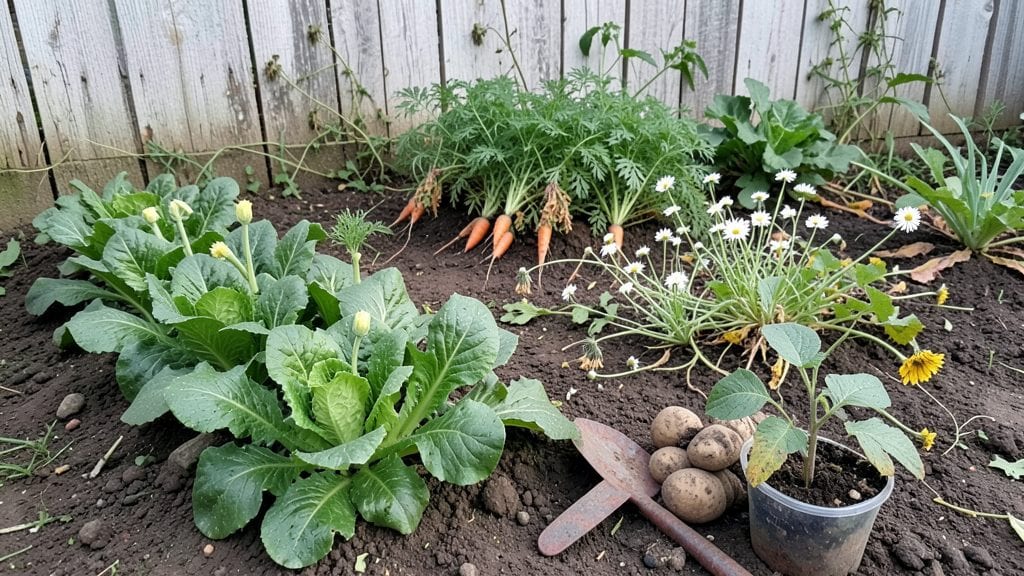
Market gardening can be either commercial or subsistence, depending on the grower's goals and how the produce is used—small family plots focus on feeding households, while larger operations sell crops to markets or restaurants.
Whether a market garden qualifies as commercial or subsistence hinges on production volume and intended use. 🌱 Subsistence gardens prioritize staple crops like tomatoes or beans, grown in modest plots to feed families, while commercial operations often cultivate high-value produce—think microgreens or heirloom tomatoes—sold through direct channels.
The line blurs when gardeners sell surplus at farmers' markets, creating a hybrid model that combines self-sufficiency with small-scale income.
What sets commercial ventures apart is their focus on profit margins and market demand. These gardens frequently invest in infrastructure like greenhouses or irrigation systems to maximize yields, while subsistence plots rely on basic tools and family labor.
Regulations also differ—commercial growers often need business licenses, while subsistence gardens typically operate under residential zoning laws.
💡 In This Article
- Market Gardening Scale and Economic Purpose
- Key Differences: Market Gardening vs. Subsistence Farming
Market gardening scale and economic purpose
Here's what actually determines whether a market garden operates commercially or for subsistence: the acreage size and production capacity. A subsistence garden typically spans just 0.1 to 0.5 acres, producing enough for a family's needs—think 50-100 pounds of tomatoes per season.
Commercial operations, however, often cover 1-5 acres or more, with yields reaching 5,000+ pounds of produce annually for direct sales. The key factor is whether the output exceeds household consumption by at least 30%, signaling a shift toward market-driven production.
The equipment and infrastructure reveal even more about economic purpose. Subsistence gardens rely on basic tools like hand trowels, hoes, and simple irrigation from rain barrels. Commercial operations, meanwhile, invest in $5,000-$50,000+ worth of equipment—drip irrigation systems, high tunnels, and even automated harvesters.
This investment reflects a focus on maximizing efficiency per square foot, crucial for turning a profit when selling to restaurants or specialty markets.
For example, a commercial grower might spend $3,000 on a greenhouse to extend the growing season by 4-6 weeks, while a subsistence gardener would never justify that cost for a 20-by-20-foot plot.
Labor allocation tells the full story. Subsistence gardens depend on family labor, with children and elders contributing during peak seasons. Commercial operations, however, often employ seasonal workers or hire specialists—like a full-time irrigation technician—to manage complex systems.
Take the case of a 2-acre commercial farm in California: they might hire 5-10 workers during peak harvest, while a subsistence garden of the same size would rely on just 2-3 family members.
This labor difference directly impacts profitability—commercial growers calculate $15-$30 per hour for specialized labor as a cost of doing business.
Market access creates another clear dividing line. Subsistence gardens rarely sell surplus because their output is designed for home consumption. Commercial operations, however, actively seek out direct sales channels—farmers' markets, CSA (Community Supported Agriculture) programs, or restaurant contracts.
A hybrid model emerges when gardeners sell 20-30% of their harvest at markets while keeping the rest for home use. This approach allows them to generate $1,000-$10,000 annually in supplemental income without fully committing to commercial-scale operations.
For instance, a 0.25-acre garden producing 300 pounds of heirloom tomatoes might sell 100 pounds at a farmers' market for $600 while using the rest for family meals.
The economic purpose also shapes crop selection. Subsistence gardens prioritize staple crops like potatoes, beans, and squash—foods with long shelf lives and high nutritional value for families.
Commercial operations, however, focus on high-value, short-season crops such as microgreens ($50-$100 per pound at market) or specialty peppers that fetch $12-$20 per pound. This difference in crop choice reflects whether the grower is optimizing for caloric output or profit margins.
For example, a 100-square-foot plot of microgreens can generate $500 in revenue in just 3 weeks, while the same space growing zucchini would yield only $50 over the entire season.
What most people don't realize is how regulations reinforce these economic distinctions. Commercial growers must navigate business licensing, food safety certifications, and sales tax requirements, which can add $500-$5,000 annually in compliance costs.
Subsistence gardens, however, operate under residential zoning laws and don't trigger these regulatory hurdles. This creates a feedback loop: commercial operations must scale to justify regulatory costs, while subsistence gardens remain small by design. 🌱
Consider the case of a hybrid garden in Portland, Oregon, where a family grows 1,000 pounds of produce annually—enough to feed their household with 20% left over.
They sell the surplus at a local farmers' market, generating $800-$1,200 per season while keeping costs low by using family labor and minimal equipment. This model proves that market gardening isn't an either/or proposition—it's a spectrum where scale, intent, and market access determine the economic purpose.
The flexibility to adapt makes it one of the most resilient agricultural practices today.