Pests
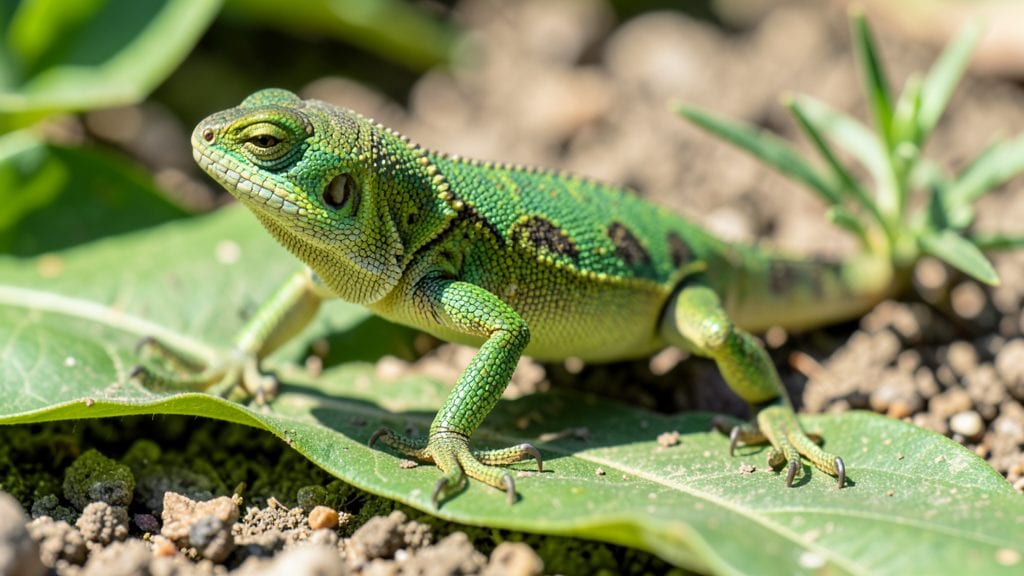
Identifying common garden lizards starts with spotting species like anoles, skinks, or fence lizards—small (2-8 inches), slender-bodied creatures that dart near plants, rocks, or sunlit paths. Their keeled scales, male dewlaps, or vivid patterns (green backs, blue throats) make them unmistakable.
These backyard reptiles thrive where sunlight and shelter overlap, often near garden edges or under patio stones. 🌿 Their behavior—quick scuttles followed by stillness—hints at their role as both predators and prey, keeping pest populations in check.
Unlike snakes, they lack venom, making them harmless (and fascinating) neighbors for most gardeners.
Regional variations matter: Southern anoles sport bright green hues, while Northern fence lizards lean toward brown with blue throats. Skinks, with their smooth scales and rounded bodies, often hide under logs or mulch.
Spotting one means your yard likely has a balanced ecosystem—just avoid handling them, as their tails can detach as a defense mechanism.
💡 In This Article
- Physical Traits of Common Garden Lizards
- Best Spots to Spot Garden Lizards in Your Yard
Physical traits of common garden lizards
The most striking difference between garden lizard species lies in their scale texture. Anoles typically have keeled scales—tiny ridges running down each scale like a dragon's back—which create a rough, almost sandpaper-like surface when you run your finger along their back.
Skinks, on the other hand, boast smooth, overlapping scales that feel almost glassy, allowing them to slip through tight spaces with ease. These scale differences aren't just for show; they're evolutionary adaptations for survival.
Keeled scales help anoles grip surfaces better for climbing, while skinks' smooth scales reduce friction when burrowing or hiding under logs. 🦎
Body shape reveals even more clues about behavior. Anoles often have slender, elongated bodies with long tails (sometimes twice their body length) that act as balance tools when darting between branches. Their legs are relatively short compared to their bodies, perfect for quick, agile movements.
Skinks, however, tend to be more compact and robust, with shorter tails that store fat reserves—ideal for species that may face food scarcity. Fence lizards strike a middle ground with their moderate length and sturdy legs, built for both climbing and sprinting across open ground.
These structural differences explain why you'll spot anoles high in trees, skinks under mulch, and fence lizards on fence posts.
Color patterns serve dual purposes: camouflage and communication. The greenish hues of tropical anoles come from specialized cells called iridophores that reflect light, creating their signature shimmer.
Northern species often sport brown or gray tones with blue throats—a territorial display that flashes when males puff out their dewlaps (those bright, fan-like throat flaps). Skinks typically show earthy browns or grays with faint stripes, blending perfectly into leaf litter.
What's fascinating is how these colors can shift seasonally: some species darken in winter to absorb more sunlight for warmth, while others brighten in spring to attract mates. 🌿
Don't overlook the limb structure—it's a game-changer for identification. Anoles have toe pads with microscopic hairs called setae that create van der Waals forces, allowing them to stick to vertical surfaces like geckos. Skinks lack these pads but compensate with strong, clawed toes for digging.
Fence lizards have a unique five-toed front foot and four-toed hind foot, a rare trait among lizards that helps them grip rough textures. These adaptations explain why you'll see anoles clinging to window sills, skinks disappearing into soil, and fence lizards perched on textured walls.
One often-overlooked trait is the tail shape and function. Lizard tails aren't just for balance—they're survival tools. Anoles and fence lizards have long, whip-like tails that can detach quickly when grabbed (a process called autotomy), distracting predators while the lizard escapes.
Skinks have shorter, thicker tails that store fat and can regenerate more completely. This tail diversity reflects their ecological niches: anoles need speed, skinks need endurance, and fence lizards need versatility. 🦎
Regional variations add another layer to identification. Southern anoles often develop brighter green backs due to higher humidity levels, while their northern cousins remain more muted. Desert-dwelling skinks may have lighter, sandy-colored scales to reflect sunlight, while forest skinks stay darker.
Even the eye color can vary: some species have golden eyes for better night vision, while others sport dark brown irises adapted to bright daylight.
These regional adaptations show how closely lizard traits are tied to their environment—proof that what you see in your garden depends entirely on where you live.